
Happy FRY-day! 😁
This week, I’ve been noticing a very dangerous trend in AI, and it’s making a serious human problem even worse. I’m breaking it down on Sunday, only for FryAI insiders.
🤯 MYSTERY AI LINK 🤯
This link leads to one of the most interesting things I’ve seen in AI recently.
🛠️ NEW AI TOOLS 🛠️
💬 PROMPT OF THE DAY:
I keep mentally returning to [past event or project]. Guide me through naming what remains unresolved, what can still be repaired, what cannot be changed, and a concrete ritual or action that marks a reasonable ending.
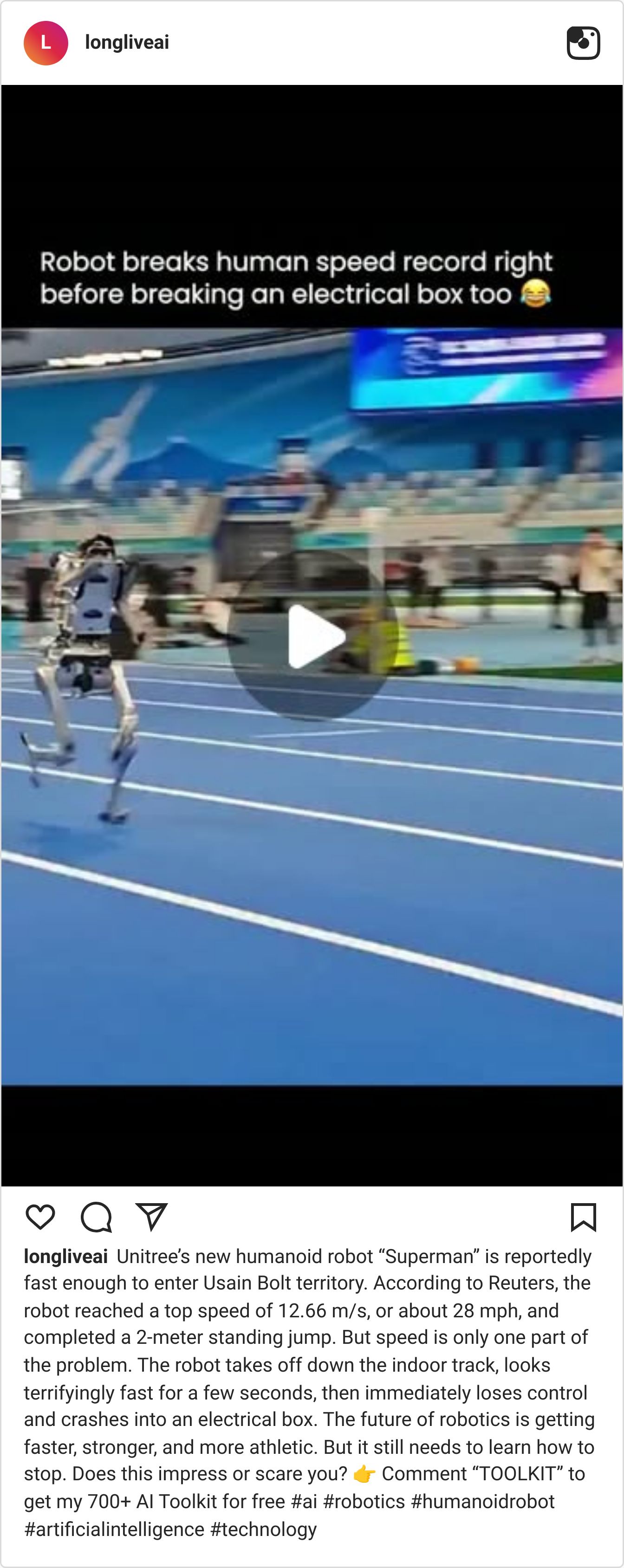
What’s cookin’? Chinese robotics company Unitree says its new humanoid robot, nicknamed “Superman,” can run at 12.66 meters per second, or about 45.6 kilometers per hour. That is slightly faster than Usain Bolt’s peak speed during his 2009 world-record 100-meter race. The robot also reportedly made a standing jump of about two meters. Unitree says it built the machine in just over three months and believes it can still improve. It’s worth noting that Unitree’s claim has not been independently confirmed, and the robot’s reported speed appears to be a short top-speed measurement, not a full 100-meter race like Bolt ran. Not to mention, while the robot may have run faster than any human in history, it ended by crashing into a wall and breaking an electrical box.
🤔 Hunter’s take: The fascinating part is not whether this robot could beat Bolt in a fair race tomorrow. It is that humanoid robots are starting to move less like machines and more like athletes. Once robots can run, jump, recover, and move through messy real-world spaces, they stop being lab demos and start becoming useful workers, soldiers, rescuers, and competitors. (But they also get one step closer to world domination!)
What’s cookin’? Firefighters are testing drones that could help put out wildfires before they spread. The idea is simple: when a small fire starts in a hard-to-reach area, a drone could get there faster than a fire truck, helicopter, or crew on foot. In California, CAL FIRE tested drones that use cameras, sensors, and AI to find a fire and drop firefighting foam on it. In Alaska, other teams tested systems that can sense the early signs of a fire, send a drone to check it, and then send another drone to fight it. These drones are not replacing firefighters or putting out fires entirely. They are more like a first response tool that buys firefighters more time.
🤔 Hunter’s take: Wildfires often become disasters before anyone can reach them. A drone does not need to put out an entire forest fire to be useful. It just needs to slow a small fire down before wind, dry brush, and heat turn it into something massive. That is the real promise here.
📈 HOW ARE THE BIG AI PLAYERS DOING?
What do you think of today's newsletter?
👆 I read all feedback. Thank you!

Hi — I’m Hunter, a PhD candidate whose work has appeared in major academic journals and popular tech outlets. I founded FryAI to make staying ahead of AI clear, accessible, and fun.
🤖 HAS AI REACHED SINGULARITY? +2%
How close are we to the point where AI surpasses human intelligence across nearly every domain and begins advancing beyond our control or prediction?

⬇️ Fry Meter rises 2% ⬇️

Unlock the story behind the score →
Inside the Kitchen members now get the full story behind every rise and fall in the Singularity Meter.
Upgrade